— By Dr. Devraj Kumar, Senior Cardiac Surgeon
For years, we’ve been told to “check our cholesterol.”
If it’s normal, we breathe a sigh of relief.
👉 But here’s the catch — normal cholesterol doesn’t always mean a healthy heart.
There’s a silent player that often goes unnoticed: Triglycerides.
🔸 The Silent Risk Lurking Beneath “Normal” Reports
In my practice as a cardiac surgeon, I meet countless patients with normal LDL cholesterol…
…yet they arrive with blocked arteries, heart attacks, or strokes.
Their common thread?
➡ Elevated triglycerides — sometimes mildly, sometimes alarmingly high — and completely ignored.
📊 Guideline reality check (ACC/AHA 2021):
• Fasting triglycerides ≥ 175 mg/dL = a risk enhancer for ASCVD (atherosclerotic cardiovascular disease).
• Persistent triglycerides > 200 mg/dL, especially with low HDL, significantly increase cardiovascular risk, even when LDL is controlled.
⸻
🧪 What Are Triglycerides, Really?
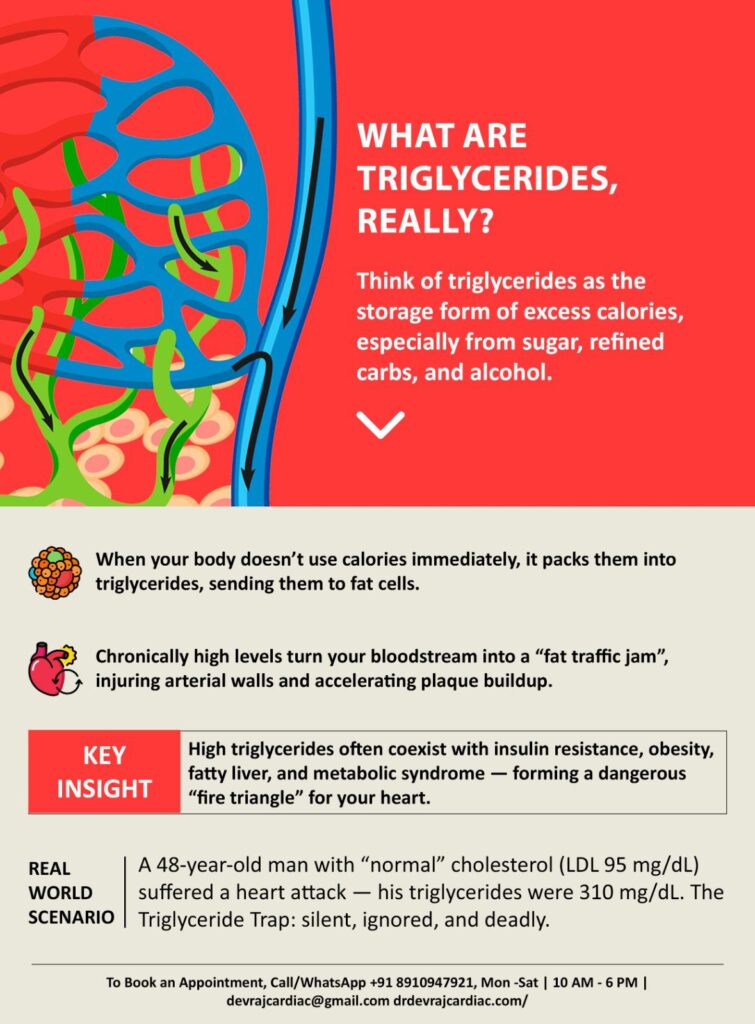
Think of triglycerides as the storage form of excess calories, especially from sugar, refined carbs, and alcohol.
• When your body doesn’t use calories immediately, it packs them into triglycerides, sending them to fat cells.
• Chronically high levels turn your bloodstream into a “fat traffic jam”, injuring arterial walls and accelerating plaque buildup.
🧠 Key insight: High triglycerides often coexist with insulin resistance, obesity, fatty liver, and metabolic syndrome — forming a dangerous “fire triangle” for your heart.
⸻
🚩 Why Triglycerides Matter Even If LDL Is Controlled
Imagine your arteries like a highway.
• LDL cholesterol is the slow, sticky truck that deposits plaques.
• Triglycerides are the reckless bikers weaving through traffic, causing endothelial injury, small dense LDL formation, and inflammation.
Clinical evidence shows:
• Non-HDL cholesterol and ApoB levels correlate more closely with actual cardiovascular events than LDL alone.
• Elevated triglycerides are a marker and a mediator — not just innocent bystanders.
⸻
🌍 Real-World Scenario1
A 48-year-old man with “normal cholesterol” (LDL 95 mg/dL) presented with an acute heart attack.
His triglyceride level? 310 mg/dL.
He’d never been advised to check or control it.
This is the Triglyceride Trap — silent, underestimated, but deadly.
⸻
🩺 What the Guidelines Say (Summarized Clearly)
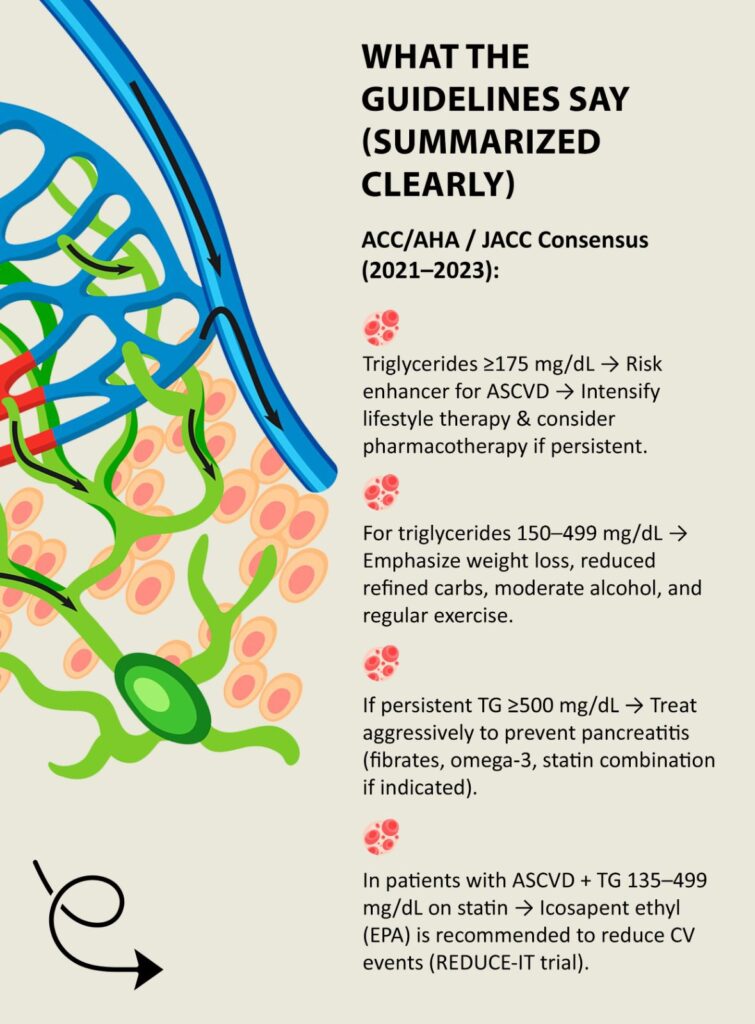
ACC/AHA / JACC Consensus (2021–2023):
• ✅ Triglycerides ≥175 mg/dL → Risk enhancer for ASCVD → Intensify lifestyle therapy & consider pharmacotherapy if persistent.
• ✅ For triglycerides 150–499 mg/dL → Emphasize weight loss, reduced refined carbs, moderate alcohol, and regular exercise.
• ✅ If persistent TG ≥500 mg/dL → Treat aggressively to prevent pancreatitis (fibrates, omega-3, statin combination if indicated).
• ✅ In patients with ASCVD + TG 135–499 mg/dL on statin → Icosapent ethyl (EPA) is recommended to reduce CV events (REDUCE-IT trial).
⸻
🔑 Action Plan: Break Free from the Trap
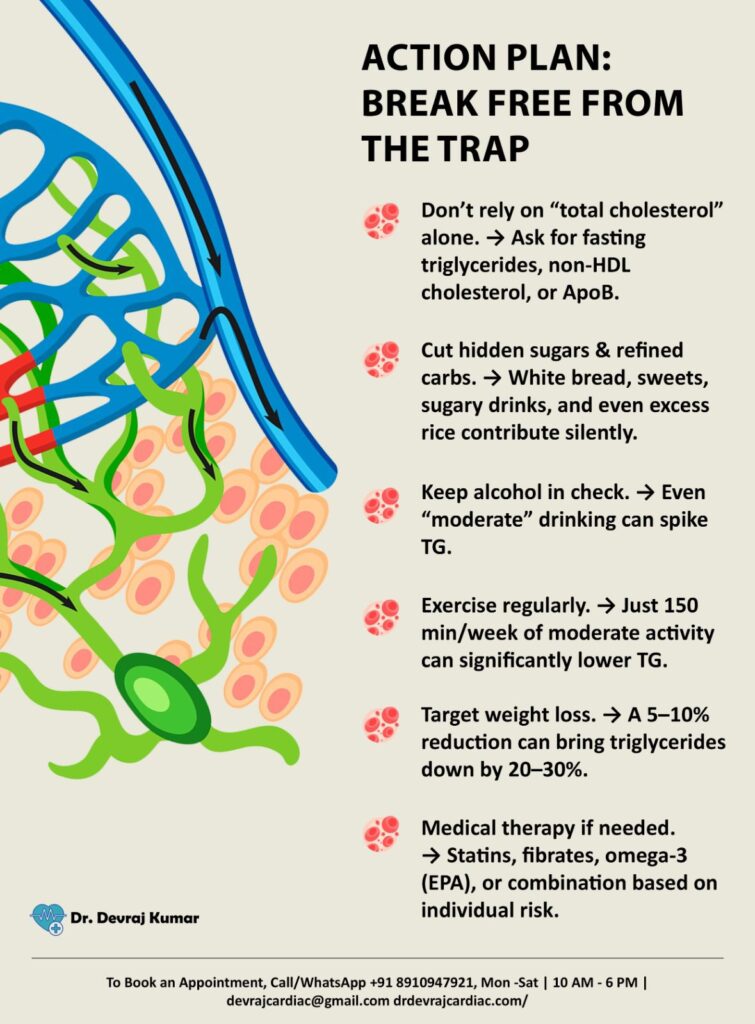
1. Don’t rely on “total cholesterol” alone.
→ Ask for fasting triglycerides, non-HDL cholesterol, or ApoB.
2. Cut hidden sugars & refined carbs.
→ White bread, sweets, sugary drinks, and even excess rice contribute silently.
3. Keep alcohol in check.
→ Even “moderate” drinking can spike TG.
4. Exercise regularly.
→ Just 150 min/week of moderate activity can significantly lower TG.
5. Target weight loss.
→ A 5–10% reduction can bring triglycerides down by 20–30%.
6. Medical therapy if needed.
→ Statins, fibrates, omega-3 (EPA), or combination based on individual risk.
⸻
⚠ Don’t Let “Normal” Mislead You
Cardiovascular disease doesn’t always announce itself.
Your lab reports might look ‘normal’— until the day they don’t.
👉 High triglycerides are a red flag that often goes unnoticed.
In modern heart care, cholesterol panels without triglyceride assessment are incomplete.
⸻
💬 Final Word
As clinicians and as individuals, it’s time to widen the lens.
Heart health isn’t just about LDL. It’s about the entire lipid picture, metabolic health, and early intervention.
✅ Check. Track. Act.
Because when it comes to your heart, “normal” can be misleading — and dangerous.
⸻
📢 If this insight resonated with you, share it — you might help someone detect risk early.
💬 What’s your view on routine triglyceride screening? Do you check beyond LDL in your practice?